Short answer: no. The spider plant (Chlorophytum comosum) isn’t toxic to cats, according to both the ASPCA and NC State University Extension. Plenty of cats are drawn to nibbling on it anyway, and that can occasionally cause mild vomiting or diarrhea. That’s just from the sheer amount of plant material sitting in the stomach, not from any toxin.
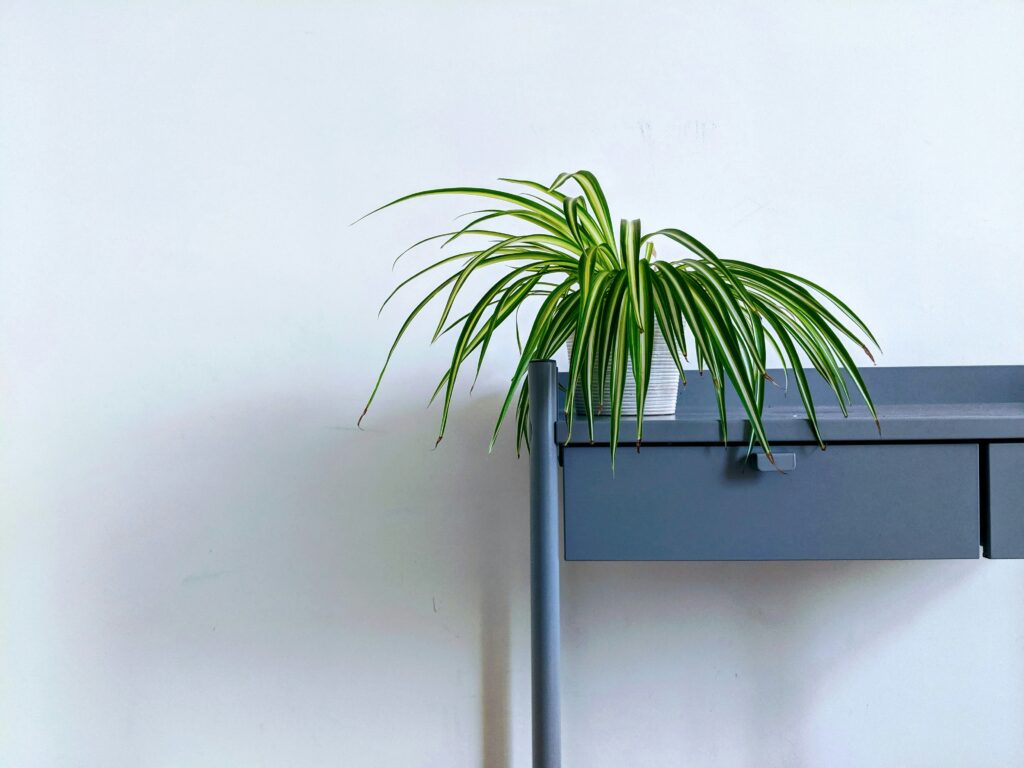
What is the spider plant, exactly?
The spider plant, botanically Chlorophytum comosum, belongs to the asparagus family (Asparagaceae), the same family as the lucky bamboo and asparagus fern from our last two articles. That family is starting to look like a genuinely good place to hunt for cat-friendly houseplants. It’s originally from South Africa and popular here mainly for its narrow, arching leaves and the small “pups” that dangle off the mother plant on thin runners.
So is it actually non-toxic?
Yes. Both the ASPCA and NC State University Extension, the same two sources we’ve been leaning on for this whole series, list Chlorophytum comosum as non-toxic to cats and dogs. The CliniTox database at the University of Zurich, one of the leading European authorities on animal toxicology, reaches the same conclusion independently and lists the spider plant as non-toxic too. Unlike lucky bamboo or asparagus fern, there’s no known toxin here, no saponins or anything else, that would trigger poisoning symptoms if your cat eats it. That makes the spider plant one of the few houseplants you can genuinely relax about, even if your cat goes to town on it.
Why do cats love it so much?
Spider plants seem to almost magnetically attract cats. The thin, mobile leaves react to every draft of air and practically beg to be pounced on, which is reason enough for plenty of cats on its own. There’s also a popular claim floating around online that spider plants contain mild hallucinogenic or opioid-like compounds, something like a catnip effect. I couldn’t find any reliable veterinary or scientific source backing that up. Neither the ASPCA nor NC State mention any such compound, and the claim doesn’t hold up the way the well-documented catnip effect does. The simple texture and movement of the leaves is probably the real explanation.
So what happens if my cat eats some?
Since the plant is non-toxic, an occasional nibble is harmless. Eat a larger amount of the fibrous leaves, though, and it can irritate the stomach, leading to vomiting or soft stool. That’s a purely mechanical effect, not a poisoning symptom. Some cat behaviorists even suspect cats deliberately chew on indigestible plant fiber to help bring up hairballs or other bits of prey they can’t digest. Whether that’s the real reason every time is up for debate, but it does show that a bit of spider plant in the stomach isn’t an emergency.
When is it worth calling the vet?
The plant itself is harmless, but call your vet if vomiting or diarrhea lasts more than a day, happens very frequently, or your cat turns lethargic and stops eating or drinking. Those symptoms usually point to something other than the spider plant, but they’re not something to shrug off.
Life with a spider plant and a cat
The spider plant is one of the more relaxed plants in our house. Since it’s non-toxic, Mickey doesn’t have to be kept strictly away from it the way she does with the lucky bamboo or asparagus fern. She’s free to sniff and nibble on it now and then. We just watch that she doesn’t rip off and swallow whole leaves in one go, mostly to avoid unnecessary vomiting. It’s a good reminder that “non-toxic” doesn’t automatically mean “any amount is fine.”
A good substitute for the riskier plants
We’ve already pointed to the spider plant as a non-toxic alternative to both lucky bamboo and asparagus fern in our earlier articles. If you want a plant with that same slender, trailing look that your cat can really go at without you worrying, the spider plant is one of the easiest picks for a cat-friendly home.
The takeaway
The spider plant is one of the genuine all-clears among popular houseplants. It’s non-toxic to cats, low-maintenance, and a nice visual contrast to the trailing growth of lucky bamboo and asparagus fern. Even if your cat enthusiastically nibbles on it, that’s harmless as long as it’s not happening in large quantities and no symptoms stick around.
This article isn’t a substitute for veterinary advice. If symptoms persist or turn severe, please contact your vet or a nearby animal hospital.